Course Summary
Our Autism Spectrum Conditions Training Course is designed to provide a sophisticated understanding of autism as a lifelong neurodevelopmental difference. Unlike introductory sessions, this Level 3 curriculum challenges common misconceptions and provides an in-depth analysis of current theories, including genetic and environmental factors, while focusing heavily on neurodiversity.
Participants will gain a technical and practical understanding of how autistic individuals experience the world, with a specific focus on:
- The Eight-Sensory-System: A comprehensive look at sensory regulation, including hyper- and hypo-sensory presentations and the role of the brain’s filtering processes.
- Executive Functioning: Understanding the cognitive processes behind self-regulation and how to mitigate cognitive overload.
- Inclusive Environments: Strategies for reducing sensory stressors and implementing flexible, individualised communication supports.
- Advocacy and Wellbeing: Evaluating the impact of stimming as a vital self-regulation tool and identifying risk factors for mental wellbeing.
By the end of this course, learners will be able to move past "one-size-fits-all" approaches, instead developing bespoke, person-centred strategies that promote resilience, inclusion, and dignity for autistic people in any professional or personal setting.
Bridging the Gap Between Theory and Practice
This training is essential for teams working across health, social care, and education who want to move beyond basic awareness toward genuine advocacy. By examining the intersection of neurobiology and daily lived experience, staff will gain the confidence to adapt physical environments and communication styles in real-time. Whether supporting pupils in the home or classroom or adults in a work or clinical setting, your team will finish the course with a refined toolkit for identifying subtle sensory triggers and championing the unique strengths of every neurodivergent individual.
Course Learning Outcomes
Review the learning objectives below. Expand each aim to view the detailed criteria this course covers.
- 1.1Describe autism as a lifelong neurodevelopmental difference and outline key features of the autistic experience.
- 1.2Identify current UK statistics and prevalence trends relating to autism.
- 1.3Explain how accurate, up‑to‑date autism knowledge supports autistic people and those connected to the autistic community.
- 1.4Analyse current theories relating to the development of autism, including genetic and environmental factors.
- 1.5Evaluate common misconceptions about autism, including those contributing to under‑recognition in females and other under‑represented groups.
- 2.1Define the terms neurotypical, neurodivergent and neurodiversity, and outline the concept of neuroplasticity.
- 2.2Explain autism as a form of neurodivergence within the wider neurodiversity paradigm.
- 2.3Discuss how autistic experiences can influence mental wellbeing, including protective and risk factors.
- 2.4Explain the importance of promoting inclusive, non‑stigmatising societal attitudes towards autism.
- 3.1Analyse how misconceptions can lead to assumptions about autistic characteristics.
- 3.2Explain how autistic characteristics, strengths and support needs vary between individuals and require personalised approaches.
- 3.3Explain executive functioning and self‑regulation, and how these relate to sensory or cognitive overload.
- 3.4Describe situations that may contribute to overstimulation and outline supportive responses.
- 3.5Explain the importance of flexible, individualised communication approaches.
- 3.6Describe how visual supports can assist some autistic people.
- 3.7Explain why structure, predictability and routine can be supportive for many autistic individuals.
- 3.8Analyse the impact of overstimulation and challenges with processing or filtering information.
- 3.9Describe strategies that promote regulation, resilience and inclusion for autistic people.
- 4.1Describe the concept of sensory regulation.
- 4.2Outline the eight‑sensory‑systems model of sensory processing.
- 4.3Describe how sensory regulation affects daily functioning and wellbeing.
- 4.4Explain the role of the brain’s sensory filtering processes.
- 4.5Define hyper‑ and hypo‑sensory experiences and how these may present in autistic people.
- 4.6Define stimming and describe its functions and forms of expression.
- 4.7Evaluate the importance of recognising stimming as a valid method of self‑regulation and emotional soothing.
- 4.8Describe ways to reduce sensory stressors and create autism‑inclusive environment.
Who is this course for?
Our Autism Spectrum Conditions training course is designed for professionals in social care, education, and health, and anyone who works with or employs autistic people.
Duration
1 day course - we can be flexible on start and finish times to suit your needs such as school run friendly times or twilight sessions.
Availability
This autism course is offered in two delivery formats:
- Remote Online: Led by a live tutor via Zoom or Microsoft Teams, allowing participants to join remotely. (Also known as virtual classroom training)
- Face-to-Face: Delivered in person at your location or a venue you arrange. (Also referred to as on-site training)
View a comparison of Remote and in-person face to face training .
Complete our quick enquiry form for a price and available dates.
Certification
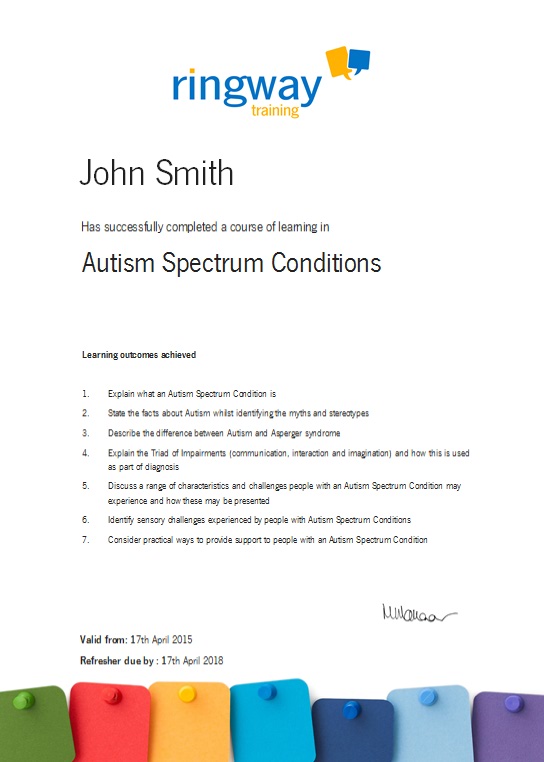
Each learner completing this course will receive a digital (PDF) certificate of learning.
Accreditation
The course contents are accredited by the Open College Network (OCN) Credit4Learning as a Level 3 course.
Choose the learning environment that works best for you: our expert-led training is offered in two convenient formats - remote tutor led online or in person face to face.
Flexible start and finish times to suit you. Contact us for available dates.
The course contents are accredited by the Open College Network (OCN) Credit4Learning as a Level 3 course.
Get a Price or more information...
Drop us a few details and we’ll send over an all-inclusive price.Just so you know, there’s no sales team here waiting and we won't add you to any marketing lists. You’ll get a quick direct reply from one of us.
Clear pricing
We ask for location (for face to face training) and approximate numbers because we include any expenses in the quotes we give so you get one clear price - no surprise added extras
More Information?
Want to dig into the details first or interested in a number of courses? No problem! Drop us a message or phone us.
Contact UsCourse FAQs