Course Summary
Empowering team leaders and managers to build resilient, inclusive, and thriving workplaces
Managing a team in high-pressure sectors like social care, health, or education requires more than just hitting targets; it requires a deep understanding of the human element. This course breaks down the complexities of mental health and neurodiversity, helping you recognise how various conditions present in different people. You will gain a clear framework for identifying workplace "psychological hazards"—such as workload and role conflict—and learn how to mitigate them before they lead to burnout or long-term absence.
Finding the Balance: High Performance and Healthy Teams
To lead others effectively, you must first understand the foundations of a healthy culture. This course explores the "Thriving at Work" standards, providing a roadmap for embedding wellbeing into your everyday routine. We cover everything from the legalities of the Equality Act 2010 to the nuances of "masking" stress, ensuring you can distinguish between a performance issue and a genuine wellbeing concern.
By the end of the day, you will have a toolkit of practical skills including:
- Spotting the Signs: Identifying early indicators of stress, anxiety, and low mood in your staff.
- Navigating Conversations: Building the confidence to approach sensitive topics using non-judgemental communication.
- Inclusive Support: Understanding neurodiversity and how to implement effective reasonable adjustments.
- Self-Care for Leaders: Setting healthy boundaries and using reflective practice to maintain your own wellbeing.
- Legal Clarity: Demystifying your duty of care under the Equality Act and Health and Safety legislation.
Investing in mental health leadership is no longer a "nice to have"—it is a core business strategy. By aligning organisational policy with empathetic, proactive management, leaders can significantly reduce staff turnover and sickness absence while boosting collective engagement. This training ensures that your approach to wellbeing is both legally sound and human-centred, preparing you to handle even the most sensitive workplace challenges with confidence and clarity.
Course Learning Outcomes
Review the learning objectives below. Expand each aim to view the detailed criteria this course covers.
- 1.1Describe what positive mental health means in a modern workplace context.
- 1.2Recognise the importance of maintaining your own wellbeing as a manager or team leader, including boundaries, reflective practice, and self‑care.
- 1.3Identify the organisational and team‑level benefits of promoting positive mental health.
- 1.4Identify a range of recognised mental health conditions and how they may present differently in different people.
- 1.5Explain the meaning of neurodiversity and how neurodivergent experiences relate to mental health, wellbeing, and workplace inclusion.
- 1.6Identify key personal, social, and environmental factors that can influence mental health.
- 1.7Consider workplace psychological hazards (e.g., workload, role conflict, trauma exposure, poor communication, discrimination) that may contribute to stress.
- 1.8Recognise the role of stigma, bias, and organisational culture in shaping mental health outcomes.
- 2.1Explain how mental health challenges can impact performance, engagement, attendance, and interpersonal relationships.
- 2.2Identify indicators that a person may be experiencing challenges with their mental health, including early warning signs.
- 2.3Recognise specific indicators relating to stress, anxiety, low mood, and depression.
- 2.4Explain the different ways people may show, mask, or react to stress, including behavioural, emotional, cognitive, and physical responses.
- 2.5Confirm the difference between performance issues and wellbeing concerns, and how to approach each appropriately.
- 2.6Recognise the impact of cumulative stress, burnout, and trauma exposure in certain roles.
- 3.1Summarise the legal responsibilities and duty of care relating to mental health, including the Equality Act (2010), Health and Safety at Work Act, and relevant organisational policies.
- 3.2Describe supportive approaches for staff experiencing mental health challenges, including empathetic listening, psychologically safe conversations, and non‑judgemental communication.
- 3.3Recognise the importance of collaborative action planning and return‑to‑work planning following absence or crisis.
- 3.4Identify a range of reasonable adjustments that may support staff with mental health conditions or neurodivergent needs.
- 3.5Consider ways to build confidence in approaching sensitive conversations about mental health and wellbeing.
- 3.6Explain ways of promoting self‑support strategies, resilience‑building, and access to wellbeing resources.
- 3.7Understand the importance of confidentiality, boundaries, and appropriate record‑keeping when supporting staff.
- 4.1Explain the meaning and value of a whole‑organisation approach to mental health, including leadership, culture, and policy alignment.
- 4.2Describe the importance of debriefing and reflective practice as methods of supporting wellbeing and reducing sickness absence and performance issues.
- 4.3Explain practical ways to implement the six core standards of Thriving at Work and embed them into everyday practice.
- 4.4Identify internal and external sources of support, including occupational health, EAPs, community services, and crisis pathways.
- 4.5Recognise the importance of signposting, early intervention, and proactive wellbeing initiatives.
- 4.6Understand how data, feedback, and staff voice can be used to improve organisational mental health strategies.
Who is this course for?
This managing mental health in education and care settings course is designed for new and experienced team leaders, supervisors, and managers working in social care, education, or healthcare settings, as well as any professional looking to improve their "people-first" leadership skills.
Duration
1 day course - we can be flexible on start and finish times to suit your needs such as school run friendly times.
Availability
This managing mental health in the workplace course is offered in two delivery formats:
- Remote Online: Led by a live tutor via Zoom or Microsoft Teams, allowing participants to join remotely. (Also known as virtual classroom training)
- Face-to-Face: Delivered in person at your location or a venue you arrange. (Also referred to as on-site training)
View a comparison of Remote and in-person face to face training .
Complete our quick enquiry form for a price and available dates.
Certification
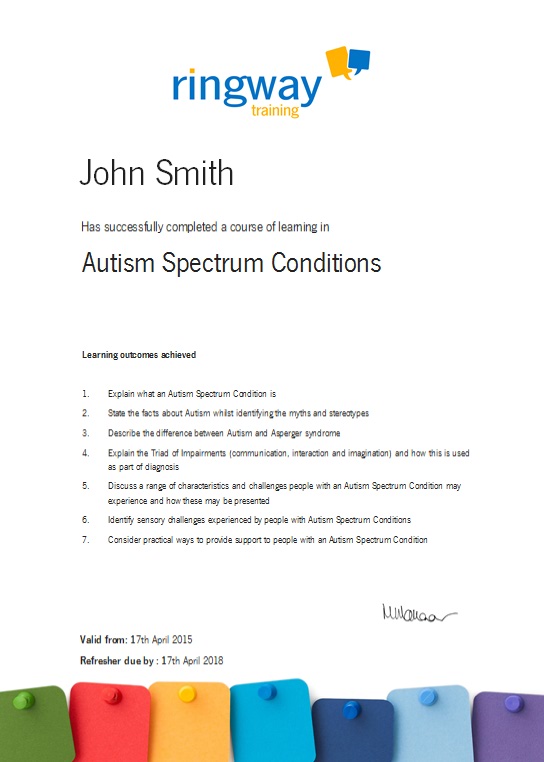
Each learner completing this course will receive a digital (PDF) certificate of learning.
Accreditation
The course contents are accredited by the Open College Network (OCN) Credit4Learning as a Level 3 course.
Choose the learning environment that works best for you: our expert-led training is offered in two convenient formats - remote tutor led online or in person face to face.
Flexible start and finish times to suit you. Contact us for available dates.
The course contents are accredited by the Open College Network (OCN) Credit4Learning as a Level 3 course.
Get a Price or more information...
Just fill in this quick form and we will email you an all inclusive price, don't worry we will never add you to any marketing lists - promise. If you want more information first thats great - just get in touch
Clear pricing
We ask for location (for face to face training) and approximate numbers because we include any expenses in the quotes we give so you get one clear price - no surprise added extras
More Information?
If you have any questions, want more information or interested in a series of courses please contact us
Contact UsCourse FAQs