Course Summary
Obsessive-Compulsive Disorder (OCD) can be an isolating and debilitating condition, yet it is frequently trivialised in modern conversation. This course provides a deep dive into the clinical realities of OCD, moving beyond the "tidiness" myth to explore the profound impact of intrusive thoughts and the compulsions that follow. By attending, you will learn to recognise the subtle, often hidden signs of the disorder and understand how it affects daily life, learning, and personal relationships.
A Holistic Approach to Compassionate OCD Support
We explore OCD through a neurodiversity-affirming lens, acknowledging that every person’s journey is different. You will gain practical skills in adapting your communication and environment to better suit those you support, ensuring your practice is both trauma-informed and psychologically safe. From understanding the link between stress and OCD to mastering the "signposting" pathways for professional help, this training equips you to be a proactive advocate for those in your care.
- Breaking the Cycle: Understanding the mechanics of obsessions and compulsions.
- Inclusive Practice: Supporting OCD within a neurodivergent and trauma-sensitive framework.
- Practical Safeguarding: Knowing when and how to escalate concerns professionally.
- Empathetic Language: Moving away from stigmatising terms to build stronger therapeutic relationships.
This OCD training for social care and education staff ensures that frontline workers can bridge the gap between clinical diagnosis and everyday support, fostering an environment where individuals feel seen, heard, and properly supported.
Course Learning Outcomes
Review the learning objectives below. Expand each aim to view the detailed criteria this course covers.
- 1.1Define Obsessive–Compulsive Disorder using accurate, up‑to‑date terminology.
- 1.2Distinguish OCD from stereotypes, misconceptions, and casual misuse of the term.
- 1.3Identify a range of signs and presentations of OCD, including less visible or internalised compulsions.
- 1.4Explain the meaning of obsessions, compulsions and intrusive thoughts.
- 1.5Describe the potential impact of OCD on daily functioning, learning, wellbeing, and relationships.
- 2.1Analyse current theories relating to the causes and development of OCD.
- 2.2Describe different types and subtypes of OCD, recognising that OCD can present in diverse ways.
- 2.3Use appropriate, respectful, and non‑stigmatising terminology when describing or supporting individuals with OCD.
- 2.4Identify practical ways to promote awareness, challenge misconceptions, and encourage empathy among peers or colleagues.
- 3.1Evaluate the relationship between OCD, trauma, and stress‑related factors.
- 3.2Explain the meaning of neurodivergence and how OCD may be experienced within a neurodiversity‑affirming framework.
- 3.3Identify ways to adapt communication, environments, and approaches to better support individuals with OCD.
- 3.4Describe how trauma‑informed principles can be applied to support people with OCD in a sensitive, inclusive, and psychologically safe manner.
- 4.1Describe appropriate steps for recognising when someone may be struggling with OCD or its impact.
- 4.2Explain when and how to escalate concerns about a person’s wellbeing in line with organisational safeguarding procedures.
- 4.3Identify suitable signposting options, including internal support, external services, and relevant safeguarding pathways.
- 4.4Outline supportive, non‑judgemental responses that respect the individual’s autonomy and dignity.
Who is this course for?
Duration
1 day course - we can be flexible on start and finish times to suit your needs such as school run friendly times or twilight sessions.
Availability
This OCD training is offered in two delivery formats:
- Remote Online: Led by a live tutor via Zoom or Microsoft Teams, allowing participants to join remotely. (Also known as virtual classroom training)
- Face-to-Face: Delivered in person at your location or a venue you arrange. (Also referred to as on-site training)
View a comparison of Remote and in-person face to face training .
Complete our quick enquiry form for a price and available dates.
Certification
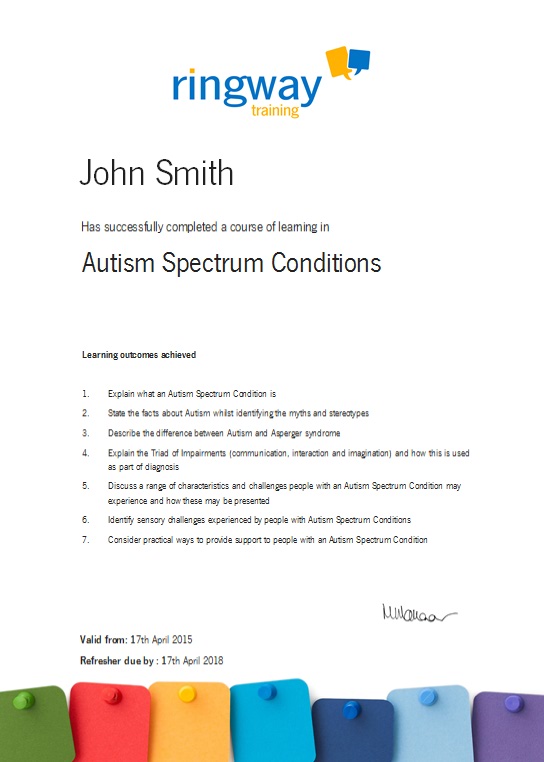
Each learner completing this course will receive a digital (PDF) certificate of learning.
Accreditation
The course contents are accredited by the Open College Network (OCN) Credit4Learning as a Level 3 course.
Choose the learning environment that works best for you: our expert-led training is offered in two convenient formats - remote tutor led online or in person face to face.
Flexible start and finish times to suit you. Contact us for available dates.
The course contents are accredited by the Open College Network (OCN) Credit4Learning as a Level 3 course.
Get a Price or more information...
Drop us a few details and we’ll send over an all-inclusive price.Just so you know, there’s no sales team here waiting and we won't add you to any marketing lists. You’ll get a quick direct reply from one of us.
Clear pricing
We ask for location (for face to face training) and approximate numbers because we include any expenses in the quotes we give so you get one clear price - no surprise added extras
More Information?
Want to dig into the details first or interested in a number of courses? No problem! Drop us a message or phone us.
Contact UsCourse FAQs