Course Summary
Pathological Demand Avoidance (PDA) is frequently misunderstood, with anxiety-driven avoidance often mislabelled as deliberate defiance, oppositional behavior, or manipulation. This interactive Level 3 course cuts through the myths to give care workers, educators, and foster carers a realistic, human-centred understanding of the PDA profile. Learners will explore how direct expectations trigger fight-or-flight responses, and how everyday environmental pressures impact an individual's autonomy and emotional well-being.
Throughout the day, participants will examine the underlying drivers of demand avoidance—including sensory processing differences, executive functioning challenges, and masking across home, school, and care settings. The curriculum moves beyond basic awareness to deliver actionable, trauma-informed strategies. Teams will practice using indirect language, shared control, humor, and co-regulation to defuse high-pressure situations, minimize shame, and build psychologically safe environments where individuals feel secure.
Why Choose Our Level 3 PDA Training?
- Low-Demand Practice: Master practical communication techniques, indirect requests, and flexible boundaries that reduce daily anxiety.
- Trauma-Informed & Relationship-Focused: Learn how tone, pacing, and adult responses directly influence behavior and prevent distress.
- Debunking Misconceptions: Differentiate PDA from oppositional behavior or trauma-linked avoidance to ensure accurate, compassionate support.
- Co-Produced Support Planning: Gain the tools to write effective PDA-informed support plans and collaborate smoothly across multidisciplinary teams.
Key Concepts Covered
- Low-Demand Approach
- A person-centred strategy that minimizes direct requests, offers choice, uses indirect language, and reduces environmental stressors to lower anxiety and avoid triggering fight-or-flight responses.
- Autonomy-Driven Anxiety
- The overwhelming sense of panic and loss of control experienced by individuals with a PDA profile when faced with demands, expectations, or perceived loss of agency.
- Co-Regulation & Shared Control
- Relational strategies where practitioners use calm presence, flexibility, negotiation, and non-confrontational communication to help an individual regulate their emotional state during periods of distress.
- Masking & Camouflaging
- Compensatory behaviors where individuals consciously or unconsciously suppress their distress to meet social or academic expectations, often masking high levels of internal anxiety until they reach a safe environment.
Course Learning Outcomes
Review the learning objectives below. Expand each aim to view the detailed criteria this course covers.
- 1.1Describe the meaning of Pathological Demand Avoidance (PDA) and demand‐avoidant profiles within the autism spectrum.
- 1.2Explain how PDA differs from other autistic profiles, anxiety‐based avoidance, oppositional behaviour and trauma‐linked avoidance.
- 1.3Describe myths and misconceptions relating to PDA, including misunderstandings about “choice”, “control” or “manipulation”.
- 1.4Explain how demand avoidance is driven by anxiety, perceived loss of autonomy, sensory overload or fear of failure.
- 1.5Analyse how PDA may present differently across age, gender, culture and neurodiversity.
- 1.6Describe how PDA affects communication, relationships, learning, daily functioning and emotional wellbeing.
- 2.1Explain possible causes and influences of demand‐avoidant behaviour, including anxiety, trauma, sensory processing differences and executive functioning challenges.
- 2.2Describe common triggers for demand avoidance, including unpredictability, transitions, perceived pressure, social demands and expectations.
- 2.3Explain how masking, camouflaging and compensatory strategies may hide or complicate PDA‐related behaviours.
- 2.4Describe how family dynamics, school environments, peer relationships and staff approaches influence demand avoidance.
- 2.5Analyse how identity‐based stressors (LGBTQ+, disability, racism, bullying) may increase vulnerability to demand avoidance.
- 2.6Explain how Pathological Demand Avoidance (PDA) interacts with other conditions such as ADHD, autism, anxiety disorders and attachment‐related needs.
- 3.1Describe trauma‐informed principles (safety, trust, choice, collaboration, empowerment) and how they apply to PDA.
- 3.2Explain how to reduce anxiety and perceived pressure through low‐demand approaches, indirect requests and collaborative communication.
- 3.3Describe ways to support emotional regulation, including co‐regulation, sensory strategies, grounding and predictable routines.
- 3.4Explain how to respond to avoidance, shutdown, escalation or refusal in ways that reduce fear, shame and distress.
- 3.5Describe how to use flexibility, negotiation, humour, shared control and relationship‐based strategies to support engagement.
- 3.6Analyse how staff responses, tone, pacing and expectations influence demand‐avoidant behaviour.
- 4.1Describe ways to identify triggers, patterns and protective factors when assessing demand‐avoidant behaviour.
- 4.2Explain how to develop or contribute to PDA‐informed support plans that include communication preferences, coping strategies and low‐demand approaches.
- 4.3Describe how to support young people during challenging situations, including transitions, new experiences and high‐pressure environments.
- 4.4Explain how to work collaboratively with families, schools, mental‐health services and multi‐agency partners.
- 4.5Describe appropriate signposting options, including autism‐specialist services, mental‐health support, advocacy and community resources.
- 4.6Evaluate how strengths‐based, person‐centred and neurodiversity‐affirming approaches promote long‐term resilience and reduce demand‐avoidant behaviour.
- 4.7Describe how reflective practice, supervision and team communication support consistent and safe responses to Pathological Demand Avoidance (PDA).
Who is this course for?
This Pathological Demand Avoidance (PDA) training course is designed for social care practitioners, education professionals, teaching assistants, SEN teams, residential care workers, and foster carers who want to develop effective, low-demand strategies for supporting individuals with a PDA profile.
Duration
1 day course - we can be flexible on start and finish times to suit your needs such as school run friendly times or twilight sessions.
Availability
This PDA course is offered in two delivery formats:
- Remote Online: Led by a live tutor via Zoom or Microsoft Teams, allowing participants to join remotely. (Also known as virtual classroom training)
- Face-to-Face: Delivered in person at your location or a venue you arrange. (Also referred to as on-site training)
View a comparison of Remote and in-person face to face training .
Complete our quick enquiry form for a price and available dates.
Certification
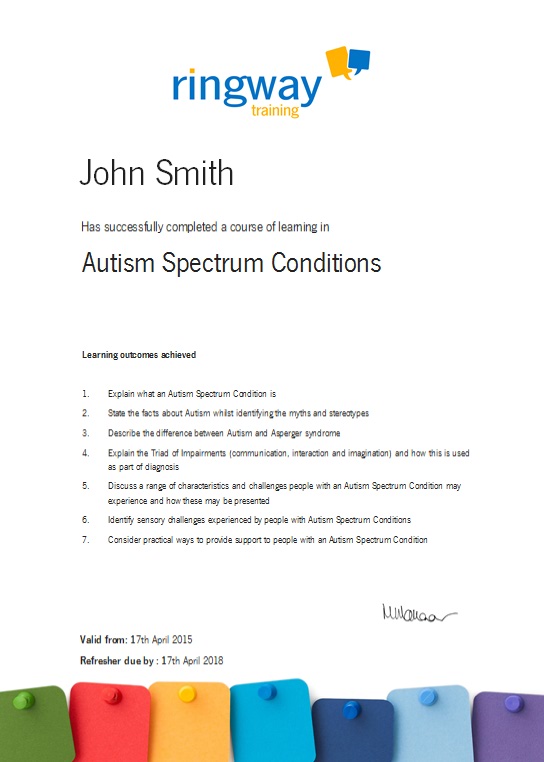
Each learner completing this course will receive a digital (PDF) certificate of learning.
Accreditation
The course contents are accredited by the Open College Network (OCN) Credit4Learning as a Level 3 course.
Choose the learning environment that works best for you: our expert-led training is offered in two convenient formats - remote tutor led online or in person face to face.
Flexible start and finish times to suit you. Contact us for available dates.
The course contents are accredited by the Open College Network (OCN) Credit4Learning as a Level 3 course.
Get a Price or more information...
Drop us a few details and we’ll send over an all-inclusive price.Just so you know, there’s no sales team here waiting and we won't add you to any marketing lists. You’ll get a quick direct reply from one of us.
Clear pricing
We ask for location (for face to face training) and approximate numbers because we include any expenses in the quotes we give so you get one clear price - no surprise added extras
More Information?
Want to dig into the details first or interested in a number of courses? No problem! Drop us a message or phone us.
Contact UsCourse FAQs