Course Summary
Working in social care or foster care means supporting individuals who have often experienced complex life paths, deep trauma, or systemic disruption. This one-day, Level 3 training course is designed to strip away the clinical mystery surrounding personality disorders, offering a grounded, empathetic, and highly practical exploration of how personality develops and how distress presents itself in real-world settings.
Throughout the day, we will look at the continuum of mental health and examine how identity, resilience, and co-occurring conditions like anxiety or depression intersect. Rather than focusing purely on diagnostic checklists, this course prioritises a trauma-informed, relational approach. You will gain actionable strategies for adapting your communication styles—particularly for neurodivergent individuals—while discovering how to safely navigate risk, interpersonal difficulties, and emotional dysregulation alongside multi-agency partners and crisis teams.
Mastering Complex Concepts in Neurodiversity and Trauma-Informed Care
To help you cut through the academic noise and excel in your day-to-day practice, we break down three foundational concepts that are vital for modern social care providers:
- Emotional Dysregulation
- This refers to an intense difficulty managing and responding to emotional states. Instead of viewing sudden emotional outbursts or withdrawals as "challenging behaviour," this course reframes them as a survival response to overwhelming distress, teaching you how to use co-regulation techniques to restore safety.
- Relational Approach
- A support framework built on the belief that positive, stable, and consistent relationships are therapeutic in themselves. For individuals whose personality development was disrupted by early relational trauma, your consistent and boundaried professional presence becomes a key tool for building resilience.
- The Mental Health Continuum
- The understanding that mental well-being is not a fixed "yes or no" state, but a fluid scale that moves between thriving, coping, struggling, and unwell. Recognising where an individual sits on this continuum at any given time allows you to adapt your support dynamically before a crisis point is reached.
Additionally, the course covers the essential UK legislation that protects vulnerable individuals, outlines your professional responsibilities, and provides clear pathways for signposting to specialist services, ensuring your care is legally robust, dignifying, and profoundly person-centred.
Course Learning Outcomes
Review the learning objectives below. Expand each aim to view the detailed criteria this course covers.
- 1.1Describe what personality disorder is and define the terms personality and disorder separately and collectively.
- 1.2Describe how human beings adapt their personality depending on relationships and situations.
- 1.3Identify statistics relating to personality disorders.
- 1.4Explain how personality develops across the lifespan, including the influence of temperament, environment and lived experience.
- 1.5Describe how trauma, attachment, neurodiversity and social learning may influence personality development.
- 1.6Explain how stigma, labels and diagnostic language can impact people with personality disorder.
- 2.1Describe the meaning of the term mental health condition.
- 2.2Define the meaning and components of the continuum of mental health.
- 2.3Identify recognised types of mental health conditions, including personality disorder.
- 2.4Explain the relationship between mental health, personality, identity and resilience.
- 2.5Explain different characteristics associated with personality disorder.
- 2.6Analyse the relationship between personality and identity.
- 2.7Describe how co‐occurring conditions (e.g., anxiety, depression, trauma‐related conditions) may influence presentation.
- 2.8Explain how social factors (stigma, discrimination, exclusion) impact wellbeing and identity.
- 3.1Explain possible causes and influences of personality disorder.
- 3.2Analyse how personality disorder may be perceived by wider society.
- 3.3Explain and evaluate different categories of personality disorder.
- 3.4Explain and evaluate different types of personality disorder.
- 3.5Explain and evaluate the social, emotional, economic and psychological impact of personality disorder.
- 3.6Consider how personality disorders can affect families, carers and supporters.
- 3.7Describe how risk, distress, emotional dysregulation or interpersonal difficulties may present.
- 3.8Explain how trauma‐informed, relational and strengths‐based approaches support understanding and reduce stigma.
- 4.1Define legislation that supports and protects people with personality disorder.
- 4.2Recognise key indicators that a person may be experiencing a personality disorder.
- 4.3Explain ways of providing support and signposting for people with personality disorder.
- 4.4Describe how to work collaboratively with mental health services, crisis teams and multi‐agency partners.
- 4.5Explain how to promote safety, wellbeing and resilience using trauma‐informed and relational approaches.
- 4.6Describe how to adapt communication and support for neurodivergent individuals or those with communication differences.
- 4.7Explain how to challenge stigma and promote dignity, respect and person‐centred practice.
- 4.8Identify sources of further support, treatment and specialist services.
Who is this course for?
This personality disorder and emotional dysregulation training course is designed for front-line social care workers, residential support staff, and foster carers who want to deepen their understanding of personality development and trauma. It is ideal for anyone looking to build practical, real-world skills to confidently support individuals experiencing emotional distress and complex interpersonal challenges.
Duration
1 day course - we can be flexible on start and finish times to suit your needs such as school run friendly times or twilight sessions.
Availability
This personality disorder course is offered in two delivery formats:
- Remote Online: Led by a live tutor via Zoom or Microsoft Teams, allowing participants to join remotely. (Also known as virtual classroom training)
- Face-to-Face: Delivered in person at your location or a venue you arrange. (Also referred to as on-site training)
View a comparison of Remote and in-person face to face training .
Complete our quick enquiry form for a price and available dates.
Certification
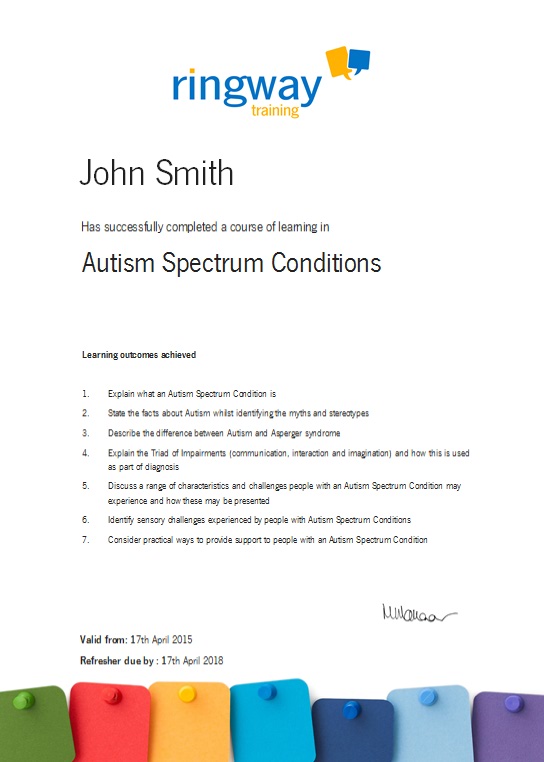
Each learner completing this course will receive a digital (PDF) certificate of learning.
Accreditation
The course contents are accredited by the Open College Network (OCN) Credit4Learning as a Level 3 course.
Choose the learning environment that works best for you: our expert-led training is offered in two convenient formats - remote tutor led online or in person face to face.
Flexible start and finish times to suit you. Contact us for available dates.
The course contents are accredited by the Open College Network (OCN) Credit4Learning as a Level 3 course.
Get a Price or more information...
Drop us a few details and we’ll send over an all-inclusive price.Just so you know, there’s no sales team here waiting and we won't add you to any marketing lists. You’ll get a quick direct reply from one of us.
Clear pricing
We ask for location (for face to face training) and approximate numbers because we include any expenses in the quotes we give so you get one clear price - no surprise added extras
More Information?
Want to dig into the details first or interested in a number of courses? No problem! Drop us a message or phone us.
Contact UsCourse FAQs