Course Summary
This course offers an in-depth exploration of Prader–Willi syndrome (PWS), focusing on providing compassionate care . Participants will journey from the genetic origins of the condition to the practicalities of daily support and safeguarding.
What You Will Learn
- Understanding PWS: Explore the genetic basis of the syndrome and how our understanding has evolved through current research and best practices.
- Characteristics & Indicators: Learn to identify core characteristics, including the cognitive profile, emotional regulation patterns, and hyperphagia, as well as how PWS presents differently from infancy through adulthood.
- Cognitive & Communication Needs: Gain insights into processing speeds, cognitive flexibility, and how PWS overlaps with other neurodevelopmental conditions like autism spectrum conditions.
- Environment & Safety: Understand the vital importance of food security, environmental controls, and implementing rights-based safeguarding measures.
- Person-Centred Support: Develop strategies for creating predictable routines that reduce anxiety, support autonomy, and foster positive relationships.
A Holistic Approach to Support
Beyond the core characteristics, this course delves into the complex intersections of physical and mental health. You will examine the metabolic and endocrine challenges inherent to PWS, alongside the nuances of emotional wellbeing and social inclusion. By evaluating the transition between childhood, adolescence, and adulthood, learners will understand how to adapt support strategies to meet changing needs. We emphasise the importance of collaborative working with families and multidisciplinary teams to ensure that safety is always balanced with dignity, empowerment, and the right to a meaningful community life.
Course Learning Outcomes
Review the learning objectives below. Expand each aim to view the detailed criteria this course covers.
- 1.1Develop an informed understanding of Prader–Willi syndrome (PWS).
- 1.2Explain how perceptions and knowledge of PWS have evolved.
- 1.3Explain current research and evidence relating to PWS.
- 1.4Describe what Prader–Willi syndrome is, including its genetic basis and key features.
- 1.5Distinguish between facts, misconceptions, and outdated narratives about PWS.
- 1.6Analyse how perceptions and understanding of Prader Willi syndrome PWS have changed over time.
- 1.7Summarise and evaluate current research, emerging evidence, and developments in best practice.
- 2.1Describe indicators and effects of Prader-Willi syndrome.
- 2.2Describe core characteristics associated with PWS.
- 2.3Explain how Prader Willi syndrome may overlap with other neurodevelopmental conditions.
- 2.4Describe how PWS may present differently across childhood, adolescence and adulthood.
- 2.5Explain how PWS can affect physical health, emotional wellbeing, learning and daily living.
- 2.6Explain and evaluate the key characteristics of PWS, including hyperphagia, cognitive profile, emotional regulation and behavioural patterns.
- 2.7Describe how some characteristics of PWS may overlap with or differ from characteristics associated with autism spectrum conditions.
- 3.1Explain communication differences and strengths commonly associated with Prader Willi syndrome (PWS).
- 3.2Evaluate how differences in cognitive flexibility, processing speed and emotional regulation can influence communication and behaviour.
- 3.3Explain additional challenges associated with PWS, including metabolic, endocrine and mental health considerations.
- 3.4Describe risks associated with food security, environmental controls, and transitions between settings.
- 3.5Describe safeguarding risks associated with food access, exploitation, and vulnerability.
- 3.6Explain how to implement proportionate, rights‑based safeguarding measures.
- 4.1Explain how to create safe, predictable environments that reduce anxiety and support autonomy.
- 4.2Describe strategies for supporting healthy routines, emotional wellbeing and positive relationships.
- 4.3Explain the importance of collaborative working with families and carers.
- 4.4Describe ways to support meaningful activities, community participation and skill development.
- 4.5Explain how to balance safety with dignity, choice, and empowerment.
Who is this course for?
Our Prader-Willi training is designed for any professional supporting individuals with Prader-Willi Syndrome. Though tailored for those working with children and young people including foster carers, education staff, and support teams — the strategies provided are universally applicable to adult care settings.
Duration
1 day course - we can be flexible on start and finish times to suit your needs such as school run friendly times or twilight sessions.
Availability
This Prader-Willi syndrome (PWS) course is offered in two delivery formats:
- Remote Online: Led by a live tutor via Zoom or Microsoft Teams, allowing participants to join remotely. (Also known as virtual classroom training)
- Face-to-Face: Delivered in person at your location or a venue you arrange. (Also referred to as on-site training)
View a comparison of Remote and in-person face to face training .
Complete our quick enquiry form for a price and available dates.
Certification
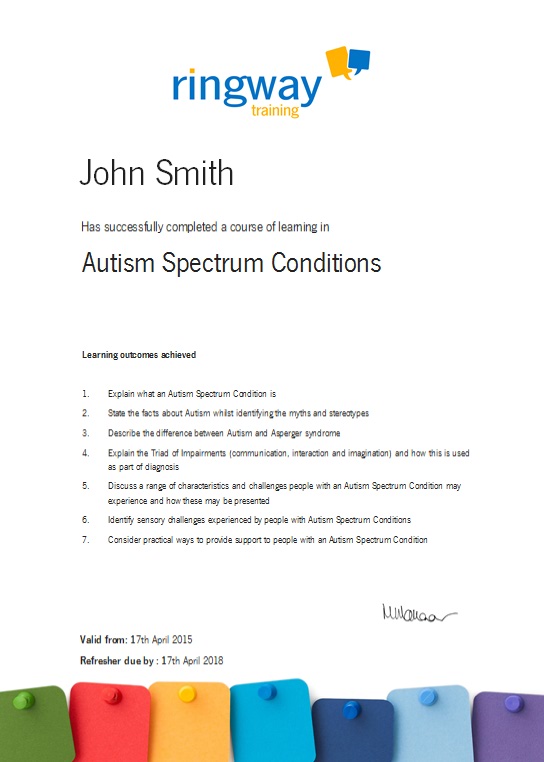
Each learner completing this course will receive a digital (PDF) certificate of learning.
Accreditation
The course contents are accredited by the Open College Network (OCN) Credit4Learning as a Level 3 course.
Other related courses you might be interested in
Choose the learning environment that works best for you: our expert-led training is offered in two convenient formats - remote tutor led online or in person face to face.
Flexible start and finish times to suit you. Contact us for available dates.
The course contents are accredited by the Open College Network (OCN) Credit4Learning as a Level 3 course.
Get a Price or more information...
Drop us a few details and we’ll send over an all-inclusive price.Just so you know, there’s no sales team here waiting and we won't add you to any marketing lists. You’ll get a quick direct reply from one of us.
Clear pricing
We ask for location (for face to face training) and approximate numbers because we include any expenses in the quotes we give so you get one clear price - no surprise added extras
More Information?
Want to dig into the details first or interested in a number of courses? No problem! Drop us a message or phone us.
Contact UsCourse FAQs