Course Summary
Developing your skills in risk assessing is a core skill for anyone working on the front line of social care. Whether you are supporting children in residential care or adults in the community, understanding how to navigate "positive risk-taking" while maintaining safety is essential. This course breaks down complex legal requirements into down-to-earth, practical steps that you can apply the very next day.
During the session, we will cover:
- The Fundamentals: Differentiating between hazards and risks, and understanding the "Hierarchy of Control."
- Legal Frameworks: Navigating the Health and Safety at Work Act and meeting CQC or Ofsted regulatory standards.
- Dynamic vs. Planned Risk: Learning how to assess situations as they happen (situational) versus formal written assessments.
- Modern Risks: Addressing contemporary challenges including digital harm, AI, substance misuse, and county lines exploitation.
- The Human Element: Using trauma-informed approaches to ensure risk assessing supports wellbeing rather than just restricting liberty.
Why Defensible Risk Management is Essential for Social Care Providers
In a sector under heavy scrutiny, "defensible decision-making" is your greatest tool. This means ensuring that if an incident does occur, your records show a clear, logical, and evidence-based process was followed. This course teaches you how to produce high-quality risk assessments using your own organisational templates, focusing on accurate recording and multi-agency communication. By refining these skills, you improve service user outcomes while protecting yourself and your organisation from professional and legal liability.
Course Learning Outcomes
Review the learning objectives below. Expand each aim to view the detailed criteria this course covers.
- 1.1Describe the purpose of a risk assessment, including prevention, harm reduction and promoting safe opportunities for growth.
- 1.2Explain and differentiate between an accident, incident, near miss and dangerous occurrence.
- 1.3Explain and compare hazards, risks, risk factors and control measures.
- 1.4Explain the importance of risk assessment for safeguarding, wellbeing, professional accountability and organisational compliance.
- 1.5Describe the principles of trauma‑informed, proportionate and defensible risk assessment.
- 2.1Explain and evaluate risk assessment duties under the Health and Safety at Work etc. Act 1974.
- 2.2Explain and evaluate regulatory requirements within social care settings including the Care Quality Commission (CQC).
- 2.3Describe and compare legal, personal and organisational limitations relating to risk occurrence.
- 2.4Explain the importance of defensible decision‑making, accurate recording and information‑sharing.
- 3.1Explain and compare planned (formal) and dynamic (situational) risk assessments.
- 3.2Analyse the five stages of risk assessment. 3.3 Describe the meaning and elements of the hierarchy of control.
- 3.3Describe and compare likelihood, frequency, severity and impact of harm occurring.
- 3.4Explain the importance of reviewing, updating and communicating risk assessments.
- 3.5Describe how supervision, team communication and reflective practice support safe risk management.
- 4.1Explain and evaluate risks that apply to professionals and services working in social care, including contextual safeguarding factors.
- 4.2Explain and evaluate examples of particularly risky behaviours, including substance misuse, online harm and digital risks (including AI), exploitation (CSE, CCE, county lines), self‑injurious behaviour and peer‑on‑peer harm.
- 4.3Demonstrate producing a risk assessment using organisational templates and evidence‑based practice.
- 4.4Explain the importance of multi‑agency working in managing complex risk.
- 4.5Describe the responsibilities of staff in recognising, reporting and escalating risk concerns.
Who is this course for?
This risk assessment course is specifically for front-line practitioners, senior support workers, and team leaders within Children’s or Adult Social Care Services. It is ideal for those working at a Level 3 standard who need to lead on risk management, supervise others, or improve the quality of their service’s safety documentation.
Duration
1 day course - we can be flexible on start and finish times to suit your needs such as school run friendly times or twilight sessions.
Availability
This Risk Assessment in Social Care training is offered in two delivery formats:
- Remote Online: Led by a live tutor via Zoom or Microsoft Teams, allowing participants to join remotely. (Also known as virtual classroom training)
- Face-to-Face: Delivered in person at your location or a venue you arrange. (Also referred to as on-site training)
View a comparison of Remote and in-person face to face training .
Complete our quick enquiry form for a price and available dates.
Certification
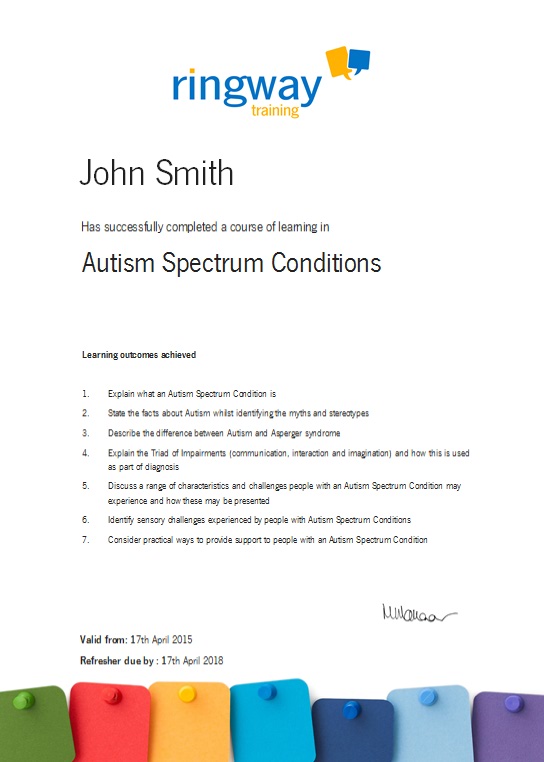
Each learner completing this course will receive a digital (PDF) certificate of learning.
Accreditation
The course contents are accredited by the Open College Network (OCN) Credit4Learning as a Level 3 course.
Choose the learning environment that works best for you: our expert-led training is offered in two convenient formats - remote tutor led online or in person face to face.
Flexible start and finish times to suit you. Contact us for available dates.
The course contents are accredited by the Open College Network (OCN) Credit4Learning as a Level 3 course.
Get a Price or more information...
Drop us a few details and we’ll send over an all-inclusive price.Just so you know, there’s no sales team here waiting and we won't add you to any marketing lists. You’ll get a quick direct reply from one of us.
Clear pricing
We ask for location (for face to face training) and approximate numbers because we include any expenses in the quotes we give so you get one clear price - no surprise added extras
More Information?
Want to dig into the details first or interested in a number of courses? No problem! Drop us a message or phone us.
Contact UsCourse FAQs